Brain-Computer Interface for Pediatric Neurorehabilitation
This project focuses on developing a Brain-Computer Interface (BCI) system that enables children with severe motor impairments to communicate and interact with digital systems using only their brain signals.
Overview
This project focuses on developing a Brain-Computer Interface (BCI) system that enables children with severe motor impairments to communicate and interact with digital systems using only their brain signals. The system is being developed as a final-year engineering project at the University of Moratuwa, with clinical collaboration from Lady Ridgeway Hospital for Children.
The primary goal is to restore a communication channel for patients suffering from conditions such as Locked-in syndrome, where voluntary muscle movement is severely limited while cognitive function remains intact.
The system translates electroencephalography (EEG) signals into digital commands, allowing patients to interact with operating systems and communication tools.
Problem
Children with severe neurological conditions such as locked-in syndrome often lose the ability to communicate or control external devices. Traditional assistive technologies typically rely on residual muscle movement, which may not be available in these patients.
This project explores the use of EEG-based brain-computer interfaces to provide a non-muscular communication pathway, enabling users to control digital interfaces directly through brain activity.
Solution
We designed a non-invasive EEG-based BCI system capable of acquiring neural signals, processing them in real time, and translating them into commands for a computer interface.
The system integrates:
- EEG signal acquisition hardware
- Real-time signal processing
- Machine-learning-based artifact removal
- Brain-signal pattern detection
- A user interface that allows interaction with digital systems
Key Features
Pediatric-Compatible EEG Headset
A custom ventilator-compatible EEG headset was designed to ensure comfort and usability for pediatric patients. The headset avoids structural components near the mouth and chin, allowing compatibility with respiratory support equipment.
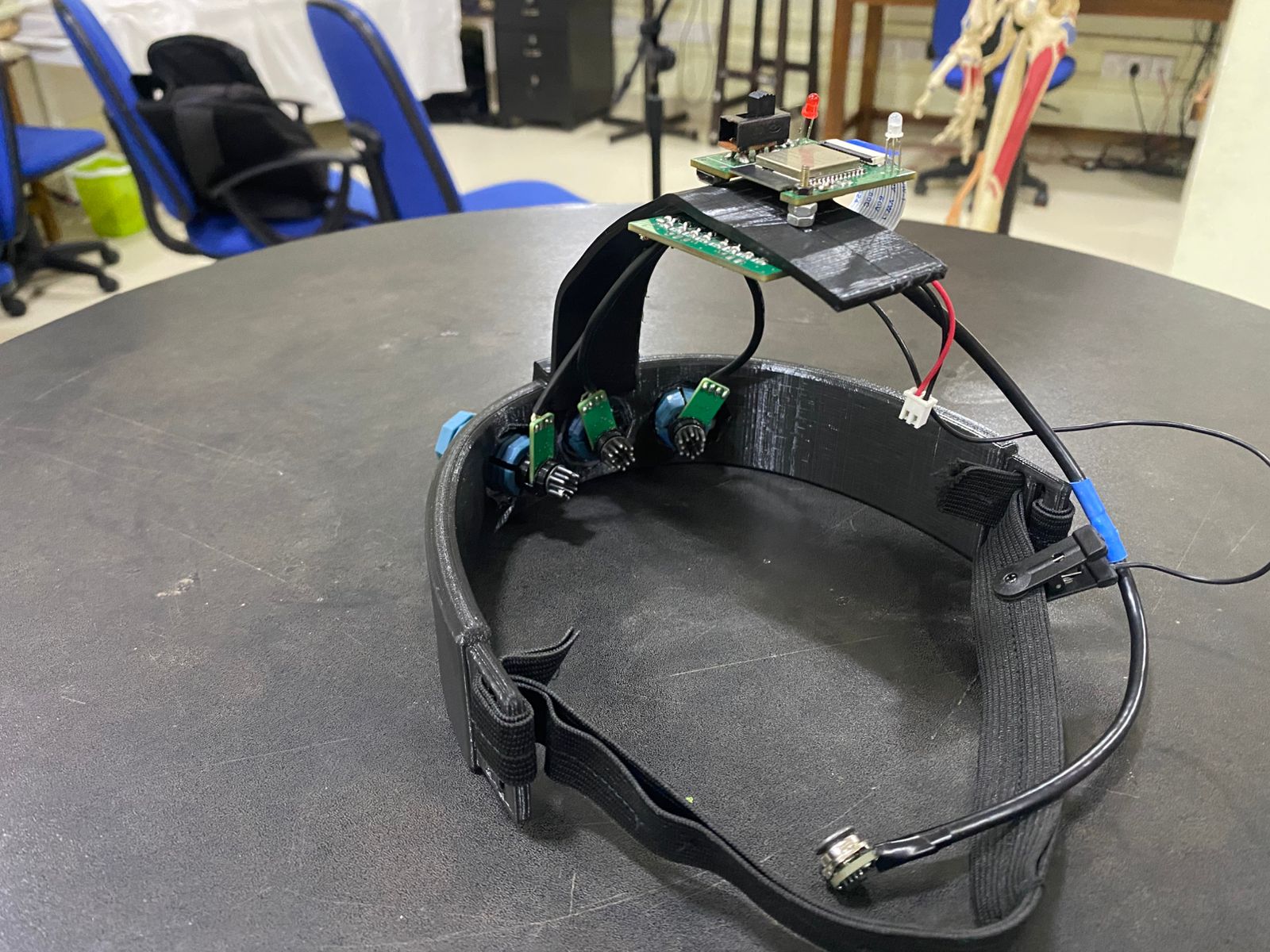 Headset.jpeg
Features include:
- Adjustable elastic top structure
- Independently mounted electrodes
- Mechanical stabilization to reduce motion-induced noise
Neural Signal Acquisition
EEG signals are acquired using the OpenBCI Cyton Board with the ADS1299 analog front-end for high-precision neural signal measurement.
This setup enables high-resolution acquisition of neural signals required for reliable BCI operation.
Signal Processing Pipeline
The system includes a signal-processing pipeline for:
- Digital filtering
- Artifact detection and removal
- Feature extraction
- Neural signal classification
A pretrained deep neural network (DeepIC Classifier) was tested for EEG artifact removal, enabling improved signal quality.
EEG Paradigms
The system architecture supports multiple BCI paradigms, including:
- Steady-State Visually Evoked Potential (SSVEP)
- P300 Event Related Potential
- Motor Imagery
These paradigms allow flexible experimentation with different brain-signal control strategies.
Experimental Validation
An initial validation experiment was designed to detect alpha rhythm changes based on whether a user's eyes are open or closed. This experiment demonstrates the system’s ability to reliably capture and interpret neural activity.
Clinical testing and case-study evaluation are planned in collaboration with Lady Ridgeway Hospital.
Technologies Used
Hardware
- OpenBCI Cyton board
- ADS1299 EEG analog front-end
- Active electrode circuits
- Custom EEG headset design
Software
- Embedded firmware for data acquisition
- Digital signal processing algorithms
- Deep neural network–based artifact removal
- Real-time EEG visualization
My Contribution
As a member of the engineering team, I contributed to several aspects of the system design and development, including:
- Signal processing pipeline development
- EEG stimulus and experiment design
- Firmware and data acquisition integration
- System testing and validation
- Research and technical documentation
Impact
This project aims to provide a low-cost, scalable BCI framework that can be adapted for patients with:
- stroke
- spinal cord injuries
- neurodegenerative diseases
By enabling brain-driven interaction with computers, the system has the potential to significantly improve communication and quality of life for patients with severe motor impairments.